The Forest
The Forest is one of the most potent and multifaceted symbols in Nathaniel Hawthorne's The Scarlet Letter, serving as a geographical and moral counterpoint to the Puritan settlement of Boston. It is a realm of darkness, freedom, and natural law, where the strictures of society lose their power and the characters can confront their deepest truths. More than a mere backdrop, the forest is an active, almost sentient presence that mirrors the inner lives of those who enter it, offering both peril and the possibility of redemption.
Definition and Character
The forest is defined by its opposition to the town. It is described as a "primeval forest" and a "moral wilderness" that images the state of Hester's own soul. It is a place of "wild, heathen Nature ... never subjugated by human law, nor illumined by higher truth" . This characterization establishes it as a space outside the jurisdiction of Puritan morality, a realm of instinct and passion. The forest is also a place of darkness and obscurity, where the sun struggles to penetrate the dense canopy, creating a "gloom" that is both literal and figurative. It is a "dismal maze" from which there seems no easy path, reflecting the moral confusion of the characters who wander within it.
The Forest as a Refuge and Site of Truth
The forest serves as a crucial refuge for Hester and Dimmesdale, a place where they can escape the relentless gaze of the community. It is here, in a secluded dell, that they hold their pivotal meeting . The forest provides the privacy necessary for them to speak openly, to acknowledge their love, and to plan a future together. In this space, Hester can remove the scarlet letter and let down her hair, an act that symbolizes a temporary liberation from her shame . The forest, in its sympathy with their joy, responds with a "flood of sunshine" , a rare moment of natural approval for their union. It is also the place where Hester reveals the true identity of Roger Chillingworth to Dimmesdale , a truth that has been hidden for seven years. The forest, therefore, becomes the site of confession and the revelation of hidden truths, a stark contrast to the public scaffold where Hester was first shamed.
The Forest as a Place of Temptation and the Supernatural
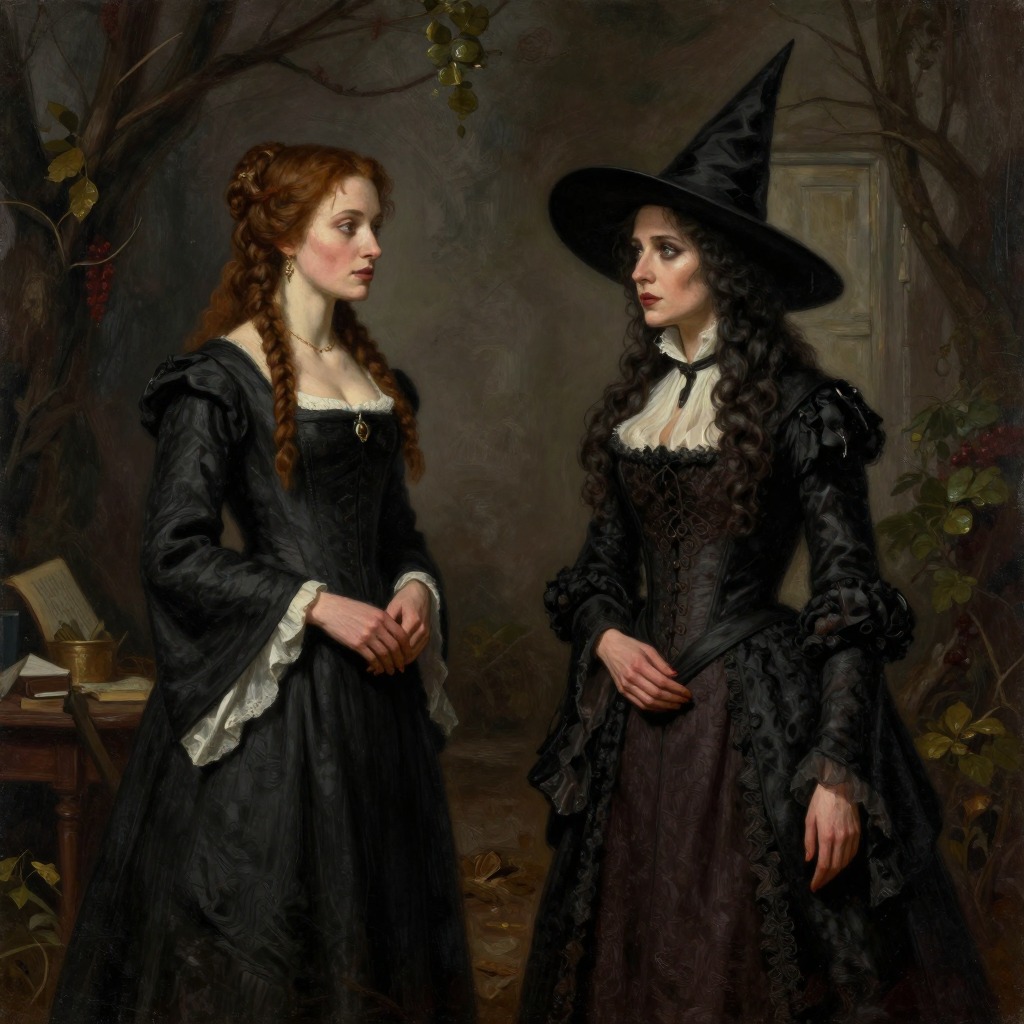
The forest is also deeply associated with the supernatural and with temptation, particularly through the figure of the "Black Man" . Local superstition holds that the Black Man haunts the forest, carrying a large book in which sinners sign their names with their own blood. Mistress Hibbins, the reputed witch, is said to make her excursions into the forest to consort with the devil . This association casts the forest as a place of moral danger, a realm where the soul can be lost. Dimmesdale himself, after his meeting with Hester, feels as though he has made a pact with the devil, and he is tempted to commit various wicked acts as he walks back to the town (E01014-E01023). The forest thus embodies the dual nature of freedom: it offers liberation from societal constraints but also threatens to unleash the darker, ungovernable impulses of the human heart.
The Forest as a Symbol of Pearl's Nature
Pearl, the child of the forest meeting, is deeply connected to this wild space. She is described as a "wild and flighty little elf" and is more at home in the forest than in the town. The forest animals, such as a partridge, a pigeon, a squirrel, and even a wolf, recognize a "kindred wilderness" in her . She decorates herself with wildflowers and becomes a "nymph child, or an infant dryad" , a spirit of the woods. The forest is the only place where Pearl's true nature can flourish, unconstrained by the judgmental eyes of the Puritan children. Her connection to the forest underscores her role as the living embodiment of her parents' passion, a product of the natural, lawless world that the forest represents.
The Forest's Narrative Significance and Contrast with the Town
The forest's primary narrative function is to provide a stark contrast to the town of Boston. The town is a place of law, judgment, and public scrutiny, where the scarlet letter is a mark of shame. The forest is a place of natural law, privacy, and potential freedom, where the scarlet letter can be removed. The journey into the forest is a journey into the self, away from the oppressive weight of social expectation. The crucial scenes of the novel—the forest meeting, the decision to flee, and the temporary casting off of the scarlet letter—all take place in this liminal space. However, the forest is not a permanent solution. The characters must eventually return to the town, and the forest's promise of freedom proves ultimately illusory for Dimmesdale, who chooses instead to confess on the scaffold. The forest, therefore, represents a tantalizing but ultimately unsustainable alternative to the rigid moral order of the Puritan world, a place where truth can be spoken but not lived indefinitely.